An article by Jessica Strutt which recently appeared in The West Australian, April 17 2010. You can view the original report here:
|

Shipwrecks, Castaways, Lost Explorers and White Tribes in Australia's History and Mythology
An article by Jessica Strutt which recently appeared in The West Australian, April 17 2010. You can view the original report here:
|
Many moons ago, I was something of an avid philatelist. You might even say that I suffered from philatelatulence. I collected stamps omniverously; first day covers, stamp packs, mint, used, abused, MUH, MNH, MLH, you name it, I was into it. I collected stamps featuring basketball, sports, shipwrecks, penguins. I have vivid memories of a particular set of Polish stamps featuring bizarre feats of exploration, such as personal submarines, etc. Eventually, I settled on collecting stamps of the Australian Antarctic Territory.
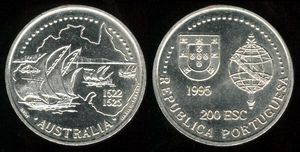
Portugal, 200 Escudos (1995)
Then, in what would be a familiar turn for many, I left stamp collecting for several years, in order to pursue more, erm, wholesome activities. Nonetheless, philately and, to a lesser extent, numismatics, have remained of interest to me. Two years ago I read Dennis Altman’s Paper Ambassadors: The Politics of Stamps (Sydney, 1986), which revolutionised my understanding of the intricacies of what mostof us consider a simple hobby. Altman’s straightforward but penetrating book alerted me to the fact that stamps act as ambassadorts of the countries for which they are issued. They are labels which have the potential to portray particular images of a nation; little advertisements of ideology, or, sometimes, territory.
And the Portuguese are still at it. In 1995, the Portuguese government issued a 200 escudos coin which celebrated the discovery of Australia in 1522 and 1525 by Portuguese navigators.
Not content with an isolated numismatical shenanigan, in 1999 the Portuguese issued a set of two stamps and a miniature sheet entitled ‘Os Portugueses na Australia’ (the Portuguese in Australia). Both were launched at the Australian Stamp expo held at Melbourne in 1999, the major theme of which was ‘discovery.’

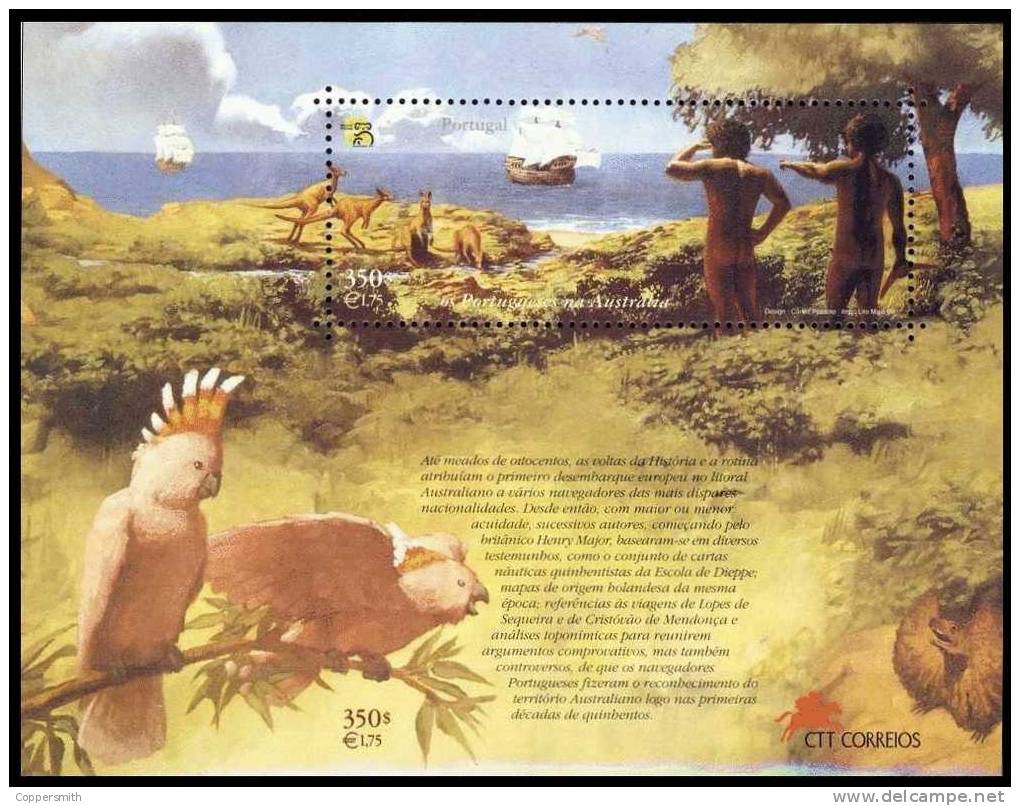
The design of these stamps is interesting: two aboriginals gesture outward (presumably in horror) at two Portuguese caravels lurking on the coast. A mob of kangaroos bounds about, their attention fixed firmly in the opposite direction. The minature sheet depicts hooting cockatoos and a frill-necked lizard, evidently cohabitating in a quasi-Edenic paradise. Slightly more seriously, the posture of the aboriginals is not aggressive – suggesting an encounter with the Portuguese sailors would have been welcome. When I look atthese designs, I can’t help but recall the finale to Mel Gibson’s awful film Apocalypto.
My Portuguese is unfortunately insufficient to decode the lengthy statement recorded on the mini sheet, but sufficient enough to recognize references to Lope de Vega, Mendoca and other Portuguese explorers thought to have been active around the continent now known as Australia in the sixteenth and seventeenth centuries.
Of course, these coins and stamps represent a rather mild assertion in the debate concerning Portuguese priority in the discovery of Australia. The present orthodox view is that the Dutchman Wilhem Jansz was the first European to discover Australia in 1606. But of course, there is a wealth of literature, much hysterical, some historical, arguing for Portuguese priority.
In any event, these coins and stamps provide an interesting example of ongoing European, although particularly Portuguese, interest in Australia and its history. Will the Dutch, Chinese, Spanish, Egyptians or Phoenecians follow suite? The collectors are waiting…

Wild Australian Children (c.1867)
The Wild Australian Children, a sideshow act in the USA in the 1860s and 1870s, were recently brought to everyone’s attention by Melissa Bellanta on her excellent blog, Vapour Trails. In an interesting entry, Bellanta discussed her recent research on ‘Lost Race’ literature, which populated fin de siècle Australian literature, pointing to the influence of ideas concerning Lemuria, racial degeneration, and literary models from England (Rider Haggard’s She and Allan Quatermain, for example) as keys to this enthusiasm.
Her article suggested an interesting point concerning the potential influence of exhibits such as these ‘Wild Australian Children’ on this intriguing literary scene, which I think is worthy of being thought about a little more:
What I didn’t realise […] was that the idea of a lost race in the Australian interior had roots in a mid-nineteenth century freak show. Indeed, from about the mid-1860s, two unfortunate kiddies from Circleville, Ohio, were billed as ‘the Wild Australian Children’ in a travelling American exhibit of freaks and ‘scientific’ curios. In the cruel argot of the business, these children were ‘pinheads’: that is, they were microcephalic, and had severe intellectual disabilities. Promotional pamphlets accompanying their exhibit described them as the members of a near-extinct cannibal tribe, plucked from the desert wilds of Australia by an explorer-adventurer, Captain Reid. According to their publicity, “phrenologists and other scientific men” had come to the view that the Wild Australians ”belonged to a distinct race hitherto unknown to civilisation”.
But what about the case of the Wild Australian Children? Their influence, if one indeed existed, must be seen as altogether more diffuse. I know of no novel or story which describes the Lemurian races of Australia as mentally damaged or pinheaded; in line with the theosophical ideas of the time, and the diffusionist arguments of W.J. Perry, most of these races were fully formed, albeit often savage, humans, corrupted by the environment into cannibalism or broader savagery. In this manner the Wild Australian Children seem more like literary remnants of Swift than precursors of Haggard, Firth, Praed, Favenc and their ilk.
However, I suppose in the notion of being plucked from cannibalism by Capt. Reid is a touching point with more traditional lost tribe ideas which were popular during the late nineteenth century: even if such ideas relate merely to the inherent superiority of European civilization. It is worth pointing out, however, that the tales told about these particular microcephaloids did not restrict them altogether to the Austral continent. P.T. Barnum exhibited another set of pinheads, claiming they hailed from a forgotten remnant Aztec empire, or from far-east Asia: exotic places not many had visited, in other words. The notion that pinheads were ‘Australian’, however, seemed to maintain some currency. Brett, a reader of Bellanta’s blog, pointed out that a similar set of pinheads (in Balkan costume!?!?!) were displayed to London audiences in 1885.
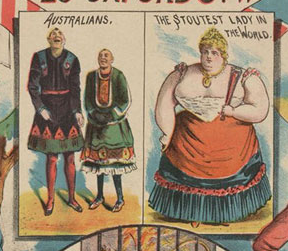
'Australians' in a London Sideshow, 1885
Equally, there was and had been a pre-existing matrix of ideas about ‘white’ tribes which had been circulating for millennia. The Lost tribes of Israel had long been a bugbear in western consciousness, and when tribes of ‘white’ Indians were discovered in New England in the 1640s there were claims that they had Hebrew origins. Periodically they would reappear in various places. In nineteenth century Britain, speculation was rife concerning British Israelites and the distribution of other tribes of Israel, all of which suggested that whites could be found in other areas throughout the world, and ensured that the notion of ‘white tribes’, as well as their international distribution, were part of the general consciousness. Occasionally, rumours of tribes could be linked to entirely other discourses. In 1834, there was some speculation about a group of Dutch living in the hinterland of New Holland’s north coast, which was apparently product of a mass of interlocking notions of geographical discovery, pseudo-scientific conclusions about inland seas, and thus reflected little of the contemporary anxieties concerning race which seemed to infect contemporary discourses on white tribes.
Concerning Haggard’s Allan Quatermain and She, novels which Bellanta points to specifically as being potentially influenced by the Wild Australian Children, surely the contemporary debate about the white origins of the immense ruins of Great Zimbabwe must have played a role in his musings? A far greater one, perhaps, than a viewing of a pair of retarded microcephaloids at a London sideshow, one would imagine. It thus seems to me more likely to me that the Wild Australian Children, as well as the white tribes of She etc, are rather manifestations drawing on the same Zeitgeist, rather than successive iterations of a singular strand of influence, falling like dominos across the nineteenth century.

White Tribe of Zimbabwe, Fate, Apr 1955
But all of this might be, in a way, demonstrative of Bellanta’s major point. Although difficult to substantiate, it remains entirely possible that this particular sideshow exhibit influenced some musings on the idea of lost Australian white tribes. We know little about the mechanics of influence of sideshow acts – their inherently ‘low’ (I use the term advisedly) status probably made them less likely to be acknowledged as influences on literary escapades of the nineteenth century.
As the case of Jungun (discussed in a previous post, and hopefully again in the near future) demonstrates, popular entertainments and sideshows could indeed exercise a remarkable, and largely invisible, impact on literary endeavours. As a case in point, although it seems clear to me that Jungun’s story was a major inspiration for Ernest Favenc’s The Secret of the Australian Desert (1895), this albino aboriginal was not mentioned at all in Favenc’s foreword, which outlined other sundry influences upon the text.
Those looking to own their own piece of ‘Wild Australian Childreniana’ (cough) should click here, and scroll down to item 25.

Jungun, with the scars of Aboriginal initiation clearly visible on his chest
Late in 1889, or early 1890, an unusual exhibit greeted visitors to Ludwig Maximilian Kreitmeyer’s infamous ‘Waxworks’ and music hall at 202-204 Bourke Street, Melbourne.
The Argus, Melbourne’s major newspaper, reported as follows on Feb 4 1890:
What is it? With a curious and pathetic interest one asks that question when looking at “Jun-Gun,” the Australian albino […] this thing brought in from the wilderness yet remains to Australia, this queer white flower from the black garden?
A “queer white flower” indeed, Jungun was discovered by a Western Australian pastoralist named Alexander McPhee. Having caught wind of rumours concerning an aboriginal ‘white man’ which cropped up among local aboriginals living upon his station, in April 1889 McPhee set out to test the truth of the matter. Eventually, after following these rumours more than three hundred miles inland, he encountered an albino aboriginal named Jungun, who was evidently their subject and origin. Living among a constellation of aboriginal groups numbering some six-hundred in total, McPhee was enamoured of Jungun’s “golden hair and fair skin.” Sensing economic advantage lurking within Jungun’s exotic features, he removed the man, along with two “coal black” members of the tribe to Perth, and thence to Melbourne and Sydney.
In Melbourne, much of the speculation focussed on Jungun’s potential origin as the offspring of a white man, even though both Jungun and his companions insisted that McPhee, their discoverer, was the first white man they had ever encountered. Still, this revelation had little impact. An anonymous author writing for The Argus deftly explained away this genetic cul-de-sac via the possibility of atavism:
Can any hope be born any theory be started, from this Jun-Gun? Though it may be sure that he was not begotten of any white man, may it not be possible that some ghastly tragedy in which a white man met his death may have exercised a pre-natal influence on him? May we not imagine some young black woman, to whom the white stranger had become dear, wedded unwoo’d in black-fellow fashion, and horribly shocked during her pregnancy by the white man’s tragic end? […] is it possible that we have a “relic” here, and on exhibition at the Waxworks at a shilling a head?
Much of the speculation concerning Jungun’s origins revolved around the fate of the lost exploration party of Ludwig Leichardt, whose party disappeared somewhere along the Condamine River, well to the east of Jungun’s homeland, some forty years earlier. According to ribald newspaper speculation, the name Jungun itself supposedly derived from a corruption of a German word (Junge– meaning boy or youth) which somehow had its origins among members of Leichardt’s party. This speculation concerning Jungun’s origin (I use the term loosely) in Leichardt’s party was dismissed out of hand by an American observer, who remarked that it was a “peculiar and romantic speculation” of the Australians.
And certainly, this was a unique time for Australia. The Federation debates were looming, independence from the UK was being considered, and now strange examples of Australians of mixed race were emerging from the desert interior. A series of peculiar anxieties were evidently in play here. Was Jungun, as an offspring of Leichhardt’s party harbinger of a united future for a untied Australia? A mere atavistic curiousity of the past? Or, through the fearsome confluence of white skin and initiation scars, tangible evidence of an inevitable descent into savagery should Australia reject its British past and embrace its local legacies?
“By Jove, it’s a white man!”

Jungun would experience an interesting reception history, in which many of these questions would be repeatedly addressed.
Perhaps the most prominent example was in furnishing the inspiration for the Australian novelist Ernest Favenc’s The Secret of the Australian Desert (1895), which told the story of the aftermath of Leichardt’s expedition. In this work, a follow up party of explorers, sent many years after Leichhardt’s disappearance, chanced upon a “depraved, bloodthirsty cannibalistic tribe of savages” in the Australian hinterland, called the Warlattas (I can’t help but notice the prominence of ‘war’ here). This novel was a vehicle for Favenc’s distinct anxieties about Australia and its future. He believed that any European interaction with Aboriginal people would only lead to the destruction and corruption of the white race, and as such those with dark skin from the interior were to be shunned as much as the Yellow Peril of the exterior.
The Warlattas were in essence Favenc’s vehicle for this theory, for, as become quickly clear to their discoverers, the Warlattas were in fact led by, and product of, the depraved imagination and influence of a fallen white man. Observing a cannibalistic orgy (“what manner of meat is that?” one explorer demanded histrionically), they are treated to the ceremonial entrance of a peculiar figure:
Then […] others appeared, supporting between them a striking and venerable figure, an old, old man, with snow-white hair and beard […] Almost as dark as the savages around, painted like them with a hideous red smear on the forehead and a white triangle on the breast, the experienced whites yet felt sure that before them they saw one of their own race.
The story of savagery and atavism was intended by Favenc as a warning to his fellow white Australians about what might happen should they mingle too long, or too thoroughly, with the aboriginal population. Favenc’s conclusion was that the Warlatta’s were once a peaceful aboriginal people, but had been corrupted by the influence of the white man. It would be wisest, his novel seemed to counsel, if the white man simply steered clear of aboriginals for everyone’s sake…

Following his death in 1892 at Healesville, Victoria, Jungun was, like many sideshow and waxworks attractions of his day, promptly forgotten. In the mid 1930s, however, he would briefly return to prominence in a short-lived newspaper debate in Western Australia, concerning his nature and origin. Part of this ongoing debate had much to do with Jungun’s possible albinoid status: for while many agreed that traces of the albino could be seen “particularly around the eyes”, others disagreed entirely, and stuck by their guns that Jungun was in fact the result of the influence of European blood. In Western Australia, however, a more promising matrix for Jungun’s European descent was found, in the persons of Wouter Looes and Jan Pelgrom de Bye, the two Batavia maroons. Indeed, one author, ‘Nor-West’, declared that McPhee’s initial mission to find Jungun was inspired by rumour of offspring of these two men, or indeed subsequent Dutch shipwrecked:
No doubt […] he hoped to find in this white man, if he did really exist, some link with the long lost Leichhardt; or, failing that, some reverted descendant of one of the few white men lost on theNorth-West coast, perhaps even a strain dating back to those two who were marooned by Pelsart after the tragic wreckof the Batavia on the Abrolhos.
As the recollections of Alexander McPhee’s sister attest, McPhee himself harboured no such aims in exhibiting Jungun. He knew, however, that he had a curiosity on his hands, one which played on the anxieties of the time, and which could command at least a shilling a head for the many visitors willing to pay. He even attempted to bring Jungun to New Zealand, but was refused the necessary permits by the Board of Protection for Aborigines in Western Australia. The tales weaved about Jungun, from his descent from Leichardt’s party to the Batavia mutineers, reflects broader concerns about race and place in Australia, more than his own commercial intentions. McPhee himself ultimately died of meningitis in a military hospital in Heliopolis after serving with the Tenth Light Horse Brigade at Gallipoli.
The story of Jungun, the shining ‘Prince of the Red Desert’, could evidently mean many things to many people.


